Text from the recording’s subtitles.
Song lyrics
Skąd ten cień na Ziemi w biały dzień?
Słońce śle ku Ziemi jasny blask.
Bliski Księżyc sunie przed jej tarczą.
Nie dotyka Słońca w oddali.
Kosmiczna trójka ustawia się w linii.
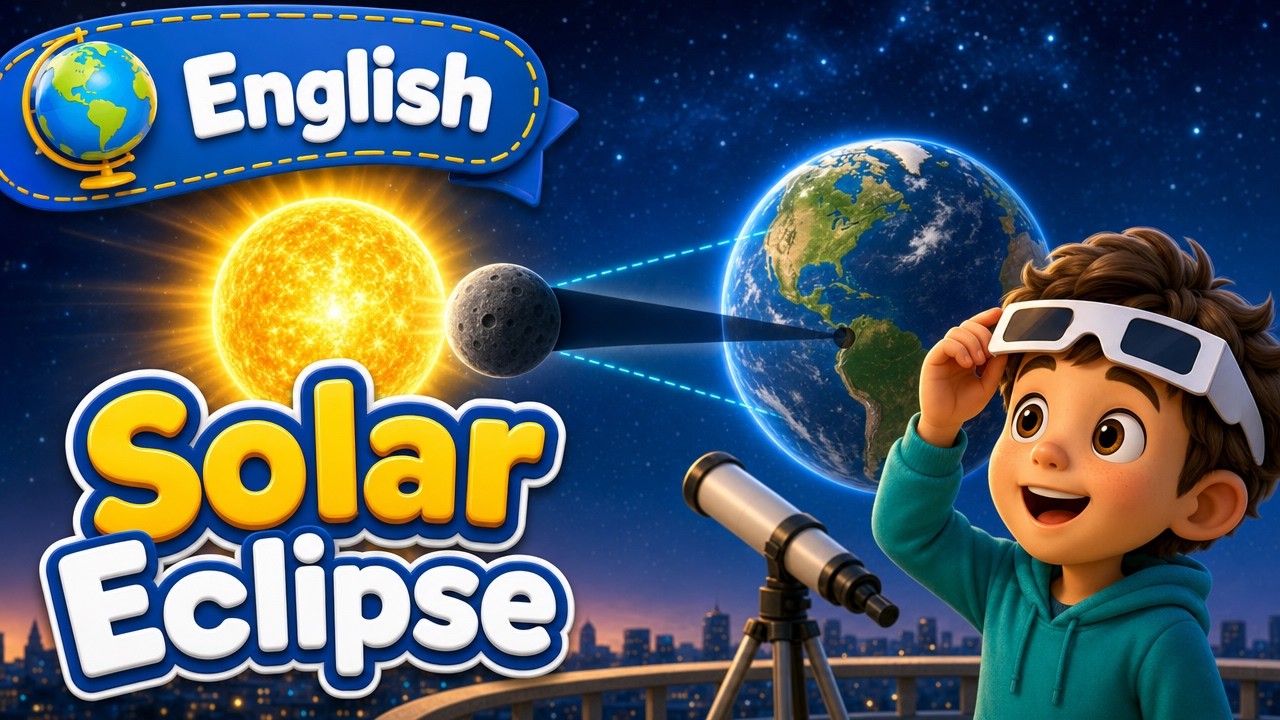
Księżyc jest między Słońcem a Ziemią.
Słońce większe, Księżyc bliżej — zdają się równe.
Słońce, Księżyc, Ziemia — jedna linia.
Księżyc kryje światło, Słońce lśni.
Mały cień Księżyca mknie po Ziemi.
Właśnie tak powstaje zaćmienie Słońca.
Cień Księżyca pędzi ponad Ziemią.
Pada tylko na jej mały obszar.
Księżyc płynie, razem z nim cień.
Cała tarcza Słońca znów jest widoczna.
Pełny blask oblewa Ziemię znów.
Słońce, Księżyc, Ziemia — jedna linia.
Księżyc kryje światło, Słońce lśni.
Mały cień Księżyca mknie po Ziemi.
Właśnie tak powstaje zaćmienie Słońca.
Częściowe kryje tylko część tarczy.
Całkowite kryje całą tarczę na chwilę.
Nie każdy nów: orbita jest nachylona.
Użyj okularów do zaćmień z filtrem.
Nie patrz wprost na Słońce bez ochrony.
Zwykłe ciemne okulary nie chronią.
Słońce, Księżyc, Ziemia — jedna linia.
Księżyc kryje światło, Słońce lśni.
Mały cień Księżyca mknie po Ziemi.
Właśnie tak powstaje zaćmienie Słońca.
Language version lyrics
What sends a racing shadow at noon?
The Sun pours light across our turning Earth.
The nearby Moon moves through our line of sight.
It never touches the faraway Sun.
Three cosmic teammates line up in space.
The Moon slips between the Sun and Earth.
The Sun is far bigger; the nearby Moon looks as big.
Sun, then Moon, then Earth—all in a line.
The Moon blocks sunlight; the Sun still shines.
Its little shadow races over Earth.
That's a solar eclipse in motion.
The Moon's small shadow sweeps across the ground.
It falls on just a narrow patch of Earth.
The Moon moves on; its shadow follows too.
The whole bright solar disk comes back in view.
Full sunlight washes over us again.
Sun, then Moon, then Earth—all in a line.
The Moon blocks sunlight; the Sun still shines.
Its little shadow races over Earth.
That's a solar eclipse in motion.
Partial: the Moon covers part of the Sun.
Total: it briefly covers the whole disk.
Not every new moon—its orbit is tilted.
Use eclipse glasses with a solar filter.
Never look straight at the Sun unprotected.
Regular sunglasses cannot protect your eyes.
Sun, then Moon, then Earth—all in a line.
The Moon blocks sunlight; the Sun still shines.
Its little shadow races over Earth.
That's a solar eclipse in motion.

 2:47
2:47